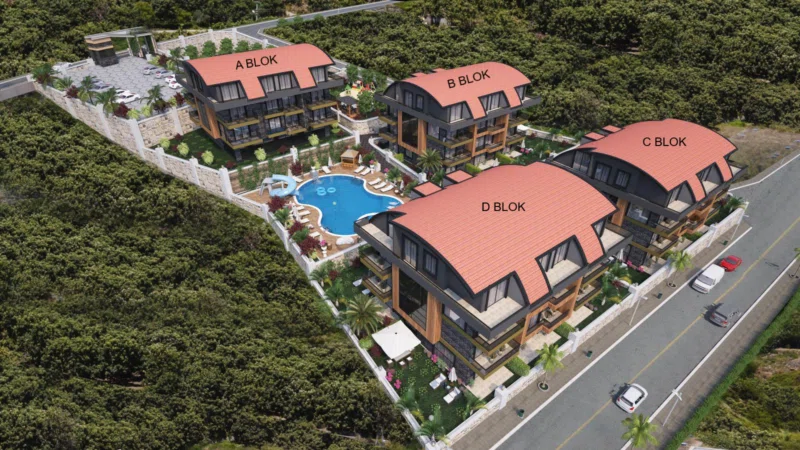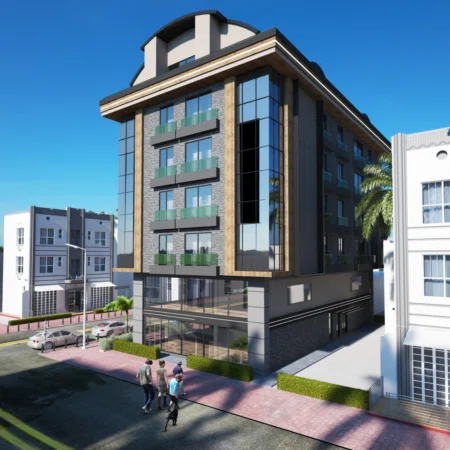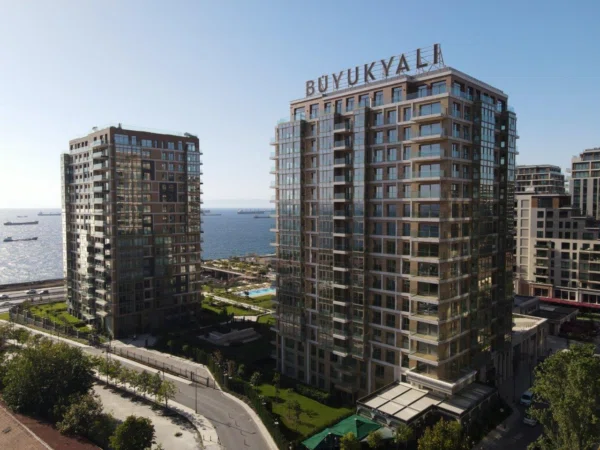
Object typeResidential
Completion dateQ4 2025
DeveloperOzak GYO
Total areafrom 134 m² to 374 m²
Down Payment50%

In 2025, according to Turkstat, residential property purchases in Turkey through mortgage financing increased by nearly 150% compared to the previous year. This growth is driven by a surge in domestic demand against the backdrop of lira stabilization. The Central Bank (CBRT) is maintaining its key rate at 38%, which directly determines the cost of mortgage loans.
Can a foreigner without a residence permit obtain a mortgage? Yes, non-residents are eligible for lending, but many opt out of this route in favor of alternatives. In this article, we examine bank offerings in detail and explore what other options are available.
Bank mortgage rates are one of the primary reasons foreign investors seek alternative long-term payment instruments when purchasing property in Turkey.
For non-residents, the rate in Turkish lira (TRY) ranges from 40% to 55% per annum.
For context: a loan from Ziraat Bank for 6 million TRY (~$154,500) over 10 years at a monthly rate of 2.59% implies a monthly payment of 162,977 TRY (~$3,665), with a total loan cost of 19.6 million TRY — meaning the overpayment exceeds the principal by more than three times.
Turkish banks offer three types of mortgage rates: fixed, variable, and hybrid.
With a fixed rate, the interest is locked for the entire loan term and does not change regardless of actions taken by the Central Bank of Turkey or inflation. This means the monthly payment remains the same from the first to the last month, providing maximum budget predictability. The fixed rate is available at Garanti BBVA and other banks, and is preferable to a variable rate in a volatile market.
With a variable rate, the interest is automatically recalculated every 1, 3, 6, or 12 months — depending on the borrower's choice — and is tied to the official Consumer Price Index (CPI) published by the Turkish Statistical Institute (TÜİK). In other words, the rate follows inflation.
A separate hybrid product offered by some banks is the mixed rate: it is fixed for up to 5 years, after which it automatically switches to a variable mode with a review frequency of the borrower's choosing — monthly, or every 3, 6, or 12 months, also based on CPI. This format allows the borrower to protect their budget over a short horizon first, and then potentially benefit from a decline in inflation.
Banks categorize applicants into several groups, offering different terms based on income and visa status.
A non-resident without a residence permit — technically the loan may be approved, but lending institutions often require a higher down payment (from 50%) and apply an elevated interest rate.
A foreigner with a residence permit or work authorization — with confirmed income, the rate approaches the national average and no additional requirements are imposed.
Self-employed individuals, freelancers, digital nomads — a mortgage is possible, but 1–2 years of tax records and an extended document package are required to confirm status.
The key bank requirement: the monthly payment must not exceed 40% of the confirmed net income.
Guarantor — a local Turkish citizen co-signer may be requested by the bank for complex profiles (non-residents, non-standard income sources). For foreigners with a residence permit or an employment contract in the country, this is almost never required.
The regulator sets maximum loan-to-value (LTV) ratios, which vary depending on the property price and energy efficiency class.
For non-resident foreigners, an LTV of 50–65% is applied in practice (meaning the down payment must amount to between 35% and 50% of the total property price). When purchasing a second apartment or villa, the LTV is reduced further.
The following banks are statistically considered the most accommodating:
The document package is standard for all foreigners:
At Turkey's current key rate, a developer installment plan is not merely an alternative — it has become the primary property purchase instrument for foreign buyers.
Installment plans may be offered on both off-plan and ready properties. For off-plan purchases at an early construction stage, the down payment is 10–15%; for ready properties, it is 30–50%. The payment schedule can be arranged on a monthly, quarterly, or semi-annual basis.
Pros:
Cons:
A mortgage in Turkey in 2026 is economically impractical for the majority of foreign buyers. Taking out a loan makes sense only for secondary market properties, or when the buyer holds a residence permit, has a high confirmed income, and requires a modest top-up to existing savings. In all other cases, it is better to select a suitable installment plan together with a broker who can help negotiate more favorable payment terms.